


Decoding the New Income Tax Act 2025: Slabs, Buybacks & Your Wallet
February 1, 2026 | by Amit Sharma

For over 60 years, Indian taxpayers have navigated the complex maze of the Income Tax Act, 1961. In Union Budget 2026-27, Finance Minister Nirmala Sitharaman officially turned the page on history.
The New Income Tax Act, 2025 is here.
While the government promises a “simplified, modern tax code,” the devil is often in the details. Does “simplified” mean lower taxes? Or just fewer pages to read? In this guide, we break down exactly what changes for your wallet starting April 1, 2026.
1. The Timeline: When Does This Start?
First, breathe easy. You do not need to file your taxes differently tomorrow.
- Current Financial Year (FY 2025-26): Continues under the old rules (Income Tax Act, 1961).
- New Regime Start Date: The New Income Tax Act, 2025 comes into effect from April 1, 2026.
- First Filing: You will file returns under this new act in Assessment Year (AY) 2027-28.
This gives you exactly one year to restructure your investments if needed.
2. Tax Slabs: The “No Change” Surprise
(Target Keyword: Income tax slab rates 2026-27)
Expectations were high for a hike in the basic exemption limit or a tweak in the 30% slab. However, the Finance Minister chose stability over disruption.
- The Verdict: Income Tax slab rates remain unchanged for now.
- The Strategy: The focus is on “Ease of Compliance” rather than lowering rates. The government believes that by removing obsolete clauses and reducing litigation, the effective burden on honest taxpayers will decrease.
Note: The “New Tax Regime” (default) and “Old Tax Regime” (with deductions) structure continues, but the text of the law governing them has been rewritten for clarity.
3. The Big Hit: Share Buybacks Taxed!
(Target Keyword: Share buyback tax rules India)
This is the single most critical update for retail investors and HNIs.
The Old Rule (Pre-2026): When a company like TCS or Infosys did a share buyback, the company paid the tax. For you (the shareholder), the money received was tax-free.
The New Rule (New Income Tax Act, 2025): The burden shifts to you. Proceeds from share buybacks will now be taxed as Capital Gains in the hands of the shareholder.
Impact Analysis:
- For Investors: This closes a major tax loophole. If you were holding IT stocks specifically for their tax-efficient buyback history, your post-tax returns will drop.
- Cost Basis: You will be allowed to deduct the cost of acquisition (the price you bought the share at) to calculate the Capital Gain.
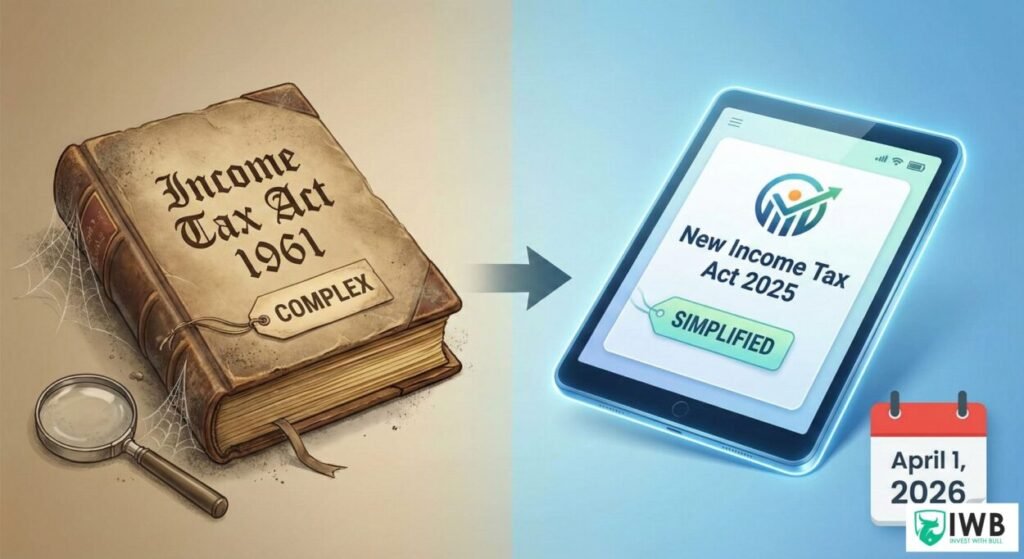
4. Visualizing the Change: Old vs. New Act
To understand the shift from the “Complex Old” to the “Simplified New,” here is a visual breakdown.
| Feature | Income Tax Act, 1961 (Old) | New Income Tax Act, 2025 |
| Effective Status | Governing law until March 31, 2026. | Effective from April 1, 2026. |
| Share Buybacks | Tax-Free for Shareholders (Company pays tax). | Taxed as Capital Gains for Shareholders. |
| Complexity | High (Prone to litigation & disputes). | Simplified (Obsolete clauses removed). |
| Tax Slabs | Multiple slabs with various surcharges. | Unchanged (Existing slabs continue). |
| Focus | Maximizing revenue collection. | Ease of compliance & reducing disputes. |
5. What Should You Do Now? (Action Plan)
Since the new act kicks in from April 2026, you have a tactical window to act.
- Review Your “Buyback” Portfolio: If you hold stocks purely for tax-free buyback gains, calculate the potential tax hit under the new Capital Gains rules. It might be time to rotate into high-dividend yielding stocks instead.
- Stay Alert for Circulars: The “fine print” of the New Act will be released in phases over the next year. We expect clarifications on specific deductions (like HRA and 80C) in the new code language.
- Consult a CA: While the law is “simplified,” the transition period (2026-27) will likely be confusing.
FAQ: The New Tax Code
Will my 80C deductions (LIC, PPF) continue?
Yes, for now. The New Act rewrites the law, but it hasn’t explicitly removed the concept of deductions for those opting for the Old Regime. However, the government’s push is clearly toward the exemption-less regime.
Is the New Income Tax Act 2025 mandatory?
The Act itself is the law of the land. You cannot choose to be governed by the 1961 Act after April 1, 2026. However, within the Act, the choice between “Regimes” (Tax structures) likely remains.
How is the buyback tax calculated?
A: It is treated as Capital Gains.
Formula: (Buyback Price – Your Purchase Price) = Capital Gain.
Tax will be applicable based on your holding period (Short Term or Long Term).

RELATED POSTS
View all


Budget 2026: The Roadmap for ‘Heal in India’ & Science R&D
February 1, 2026 | by Amit Sharma

Budget 2026 Market Analysis: Top Sectors & Stocks to Watch
February 1, 2026 | by Amit Sharma

How Much More Money Will You Take Home After Budget 2026? New Income Tax Rules Explained for Salaried Indians
February 23, 2026 | by Amit Sharma