


New Income Tax Act 2025 & Union Budget 2026: The Comprehensive Guide to India’s Tax Revolution
February 3, 2026 | by Amit Sharma
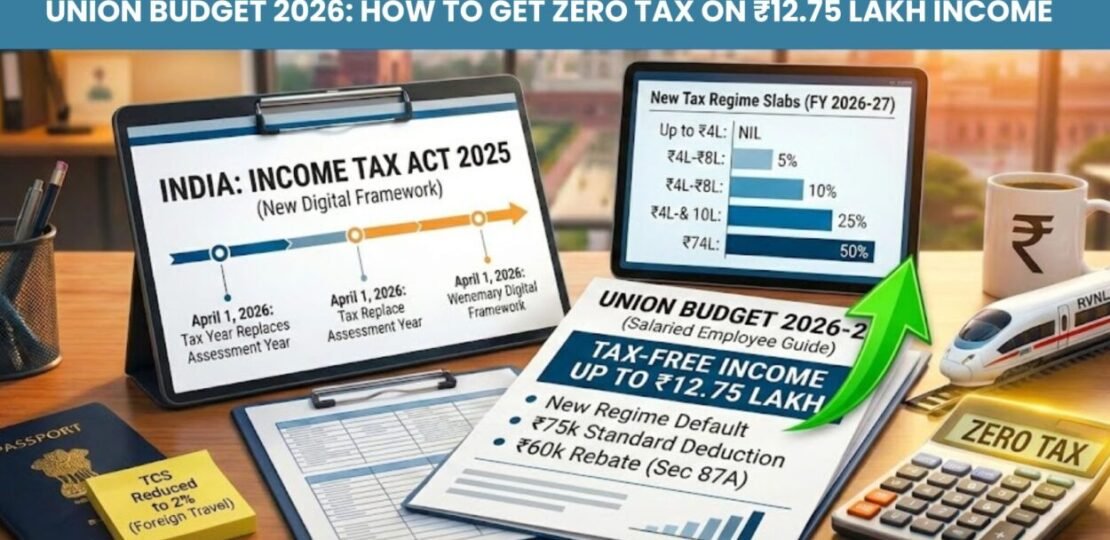
The Indian financial ecosystem is undergoing its most significant overhaul since independence. With the Union Budget 2026 (presented on February 1, 2026) and the landmark Income Tax Act 2025 (set to take effect from April 1, 2026), every salaried professional, investor, and business owner must re-evaluate their financial strategy.
This guide breaks down the complex legal shifts, the new tax slabs, and the hidden “rebate hacks” that can help you achieve zero tax liability even with a high income.
1. The Death of the 1961 Act: Understanding the Income Tax Act 2025
For over six decades, the Income-tax Act, 1961 was the backbone of Indian taxation. However, its complexity led to endless litigation. The Income Tax Act 2025 is not just a revision; it is a complete replacement designed for a digital-first India.
Key Structural Changes:
- Goodbye “Assessment Year”: One of the biggest points of confusion for taxpayers was the difference between the Previous Year (PY) and the Assessment Year (AY). The new Act eliminates this. Starting April 1, 2026, we will strictly use the term “Tax Year”.
- Simplified Legal Language: The Act has been rewritten in “plain English” to reduce the need for expensive consultants. Clauses have been renumbered and consolidated (e.g., the new Clause 202 handles individual tax rates).
- Digital-First Enforcement: The Act provides a permanent legal basis for automated digital compliance. From AI-driven scrutiny to instant “Nil TDS” certificates, the goal is to remove the “human interface” that often led to corruption or delays.
2. Union Budget 2026: The “Zero Tax” Milestone for Salaried Employees
The Finance Minister’s 2026 proposals are a bridge to the new Act. The most talked-about change is the effective tax-free income limit of ₹12.75 lakh.
Revised Tax Slabs (FY 2026-27 / Tax Year 2026)
The New Tax Regime is now the default. If you don’t explicitly choose the Old Regime, these are the rates you will pay:
| Taxable Income (New Regime) | Tax Rate |
| Up to ₹4,00,000 | NIL |
| ₹4,00,001 to ₹8,00,000 | 5% |
| ₹8,00,001 to ₹12,00,000 | 10% |
| ₹12,00,001 to ₹16,00,000 | 15% |
| ₹16,00,001 to ₹20,00,000 | 20% |
| ₹20,00,001 to ₹24,00,000 | 25% |
| Above ₹24,00,000 | 30% |
The ₹12.75 Lakh “Zero Tax” Calculation
How can someone earning nearly ₹13 lakh pay zero tax? It’s a combination of three major pillars:
- Standard Deduction: Increased to ₹75,000 for salaried individuals.
- Section 87A Rebate: The rebate has been hiked to ₹60,000 for those with taxable income up to ₹12 lakh.
- The Result: When you subtract the ₹75k deduction from a ₹12.75L salary, your taxable income becomes ₹12L. The tax on ₹12L is exactly ₹60k, which is then fully covered by the new rebate.
View Official Union Budget 2026-27 Documents
3. Major Procedural Relief: TDS, TCS, and Property
The Union Budget 2026 and the 2025 Act focus heavily on “Ease of Living” through procedural simplifications.
TCS Reduction on Foreign Travel (The 2% Rule)
In a move to boost the tourism sector, the government has simplified Tax Collected at Source (TCS).
- Old Rule: 5% or 20% depending on the threshold and purpose.
- New Rule: A flat 2% TCS on all overseas tour packages and foreign remittances (except for business-related travel). This is a massive relief for families planning international vacations in 2026.
Buying Property from NRIs: No TAN Needed
Previously, if a resident Indian bought a house from an NRI, they had to apply for a Tax Deduction Account Number (TAN) to deposit the TDS.
- 2026 Update: The requirement for a TAN is removed. You can now deposit the TDS using just your PAN via a simplified digital challan.
4. Investing in 2026: SGBs, Buybacks, and Capital Gains
The government is tightening the rules on “tax-free” loopholes for high-net-worth investors.
Sovereign Gold Bonds (SGB) Taxation
SGBs were the darling of the middle class because the capital gains at maturity were tax-free.
- The 2026 Twist: This tax-free benefit is now restricted to original primary subscribers. If you buy SGBs from the secondary market (stock exchange) after April 1, 2026, your maturity gains will be taxed at 12.5%.
Stock Buyback Changes
Stock buybacks are no longer “tax-free” for shareholders. Starting in the 2026 Tax Year, the income from a buyback will be treated as Capital Gains in the hands of the investor and taxed accordingly. Companies will no longer pay the buyback tax; the burden has shifted to you.
5. Sector Outlook: Why RVNL, IRFC, and Infrastructure are Key
The Budget 2026 allocated a record ₹12.2 lakh crore for capital expenditure, with a massive chunk going to the Indian Railways.
- Railway Infrastructure: The launch of 7 new High-Speed Rail corridors and the completion of 100% electrification by mid-2026 keep stocks like RVNL (Rail Vikas Nigam Limited) and IRFC (Indian Railway Finance Corporation) in a strong fundamental position.
- SME Growth Fund: A new ₹10,000 crore SME Growth Fund was introduced to provide equity support to manufacturing units, creating a ripple effect for financial service providers.
6. Advanced Tax Planning: Strategic Moves for 2026
With the shift to the Income Tax Act 2025, your filing strategy must change.
- Updated Returns (ITR-U): The deadline to file an “Updated Return” has been extended from 24 months to 48 months. However, the penalty increases significantly the longer you wait (up to 70% of the additional tax).
- Motor Vehicle Claims: Interest awarded by the Motor Vehicle Claims Tribunal is now completely tax-exempt for individuals and their legal heirs under the new Act.
7. Frequently Asked Questions (FAQs)
What is the main objective of the Income Tax Act 2025?
The main goals are the simplification of tax laws, reducing legal disputes, improving the taxpayer experience, and enabling 100% digital compliance.
Can I still use the Old Tax Regime in 2026?
Yes, but you must explicitly opt-in at the time of filing your return. The New Tax Regime remains the default.
Is the ₹12 lakh zero-tax limit available for businesses?
No, the Section 87A rebate of ₹60,000 is specifically for resident individuals. Non-residents (NRIs) and HUFs have different rules.
What happens to my old tax records from the 1961 Act?
The Income Tax Act 2025 includes “saving clauses” that ensure any pending litigation or records under the old 1961 Act remain valid until they are resolved.
Is there any change in GST in the 2026 Budget?
The 2026 Budget focused on “Structural Tightening.” While rates were mostly unchanged, new rules for provisional refunds for exporters were introduced to improve cash flow.
Conclusion: Preparing for April 1, 2026
The combination of Budget 2026 and the Income Tax Act 2025 is a clear signal: the government wants you in the New Tax Regime. With an effective tax-free limit of ₹12.75 lakh and simplified NRI property rules, the focus is on ease of doing business and living.
Ensure you and your family review your investment portfolios, especially SGBs and Buyback-heavy stocks, to avoid surprise tax hits in the new Tax Year.

RELATED POSTS
View all


Budget 2026: Beyond the Farm Laws – The ‘High-Value’ Shift
February 1, 2026 | by Amit Sharma

Decoding the New Income Tax Act 2025: Slabs, Buybacks & Your Wallet
February 1, 2026 | by Amit Sharma
How Much More Money Will You Take Home After Budget 2026? New Income Tax Rules Explained for Salaried Indians
February 23, 2026 | by Amit Sharma