


Budget 2026: Beyond the Farm Laws – The ‘High-Value’ Shift
February 1, 2026 | by Amit Sharma

For decades, Indian agriculture budgets focused on subsidies and Minimum Support Prices (MSP) for wheat and rice. The Union Budget 2026-27 marks a structural shift. The government is no longer just asking farmers to “grow more”; it is asking them to “grow better.”
With a record allocation of ₹1.63 lakh crore, the focus has pivoted to High-Value Agriculture and Digital Public Infrastructure (DPI). The launch of the AI-powered Bharat-VISTAAR platform signals that data is now as critical as fertilizer.
Here is how the rural economy is being rebooted.
1. Bharat-VISTAAR: The ‘UPI Moment’ for Farming
(Target Keyword: Bharat-VISTAAR scheme details)
Just as UPI revolutionized payments, Bharat-VISTAAR (Virtually Integrated System to Access Agricultural Resources) aims to revolutionize farm knowledge.
- What is it? A multilingual AI platform that integrates the “AgriStack” (farmer data) with ICAR’s scientific best practices.
- How it helps: Instead of generic advice, a farmer in Vidarbha will receive a personalized alert in Marathi: “Soil moisture low in Plot B. Apply irrigation tomorrow. Pest risk detected.”
- The Goal: To bridge the gap between scientific labs and the farmer’s land using AI.
2. The “High-Value” Pivot: Coconut, Cocoa & Sandalwood
High-value agriculture India
The government realizes that growing wheat alone won’t double farm incomes. The budget incentivizes a shift to cash-rich plantation crops.
- Coconut Promotion Scheme: A massive replantation drive to replace old, low-yielding trees with new hybrid varieties to boost exports.
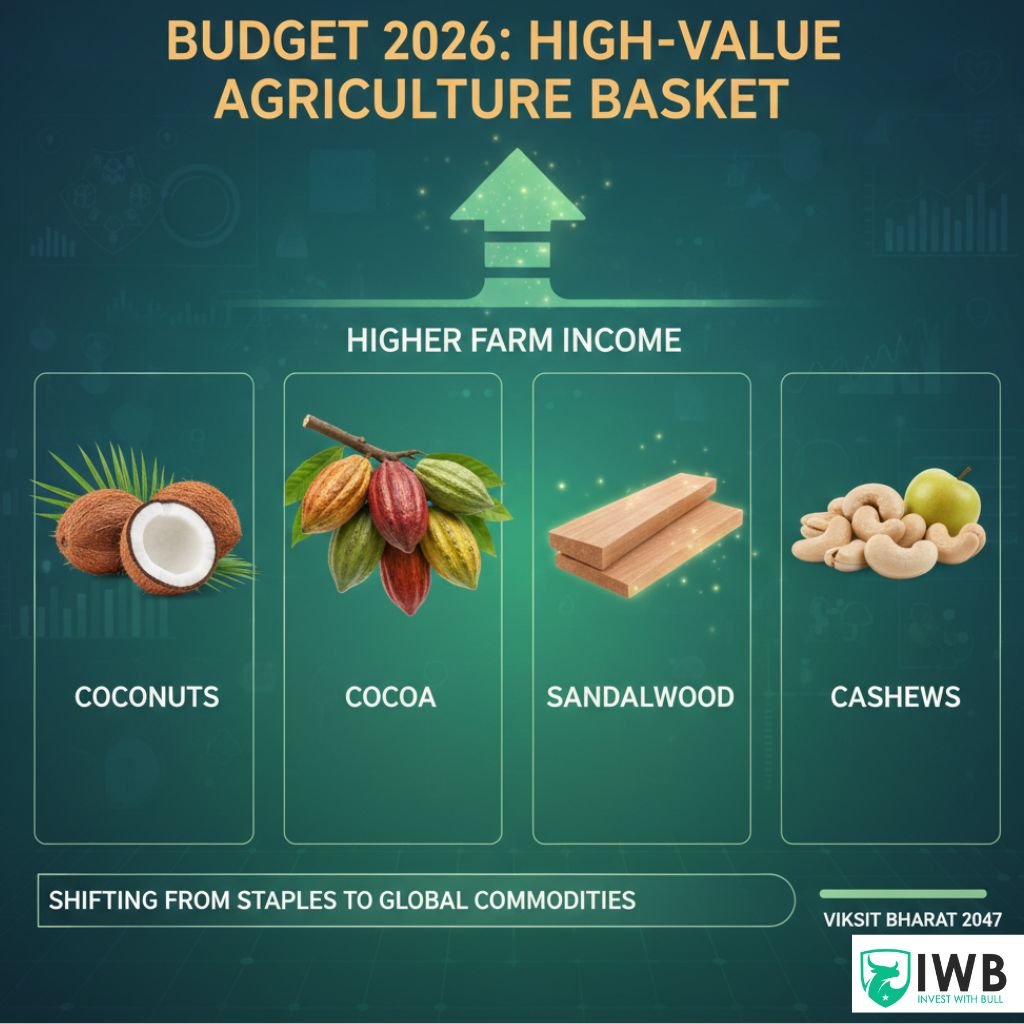
- The “Exotic” Push: Dedicated clusters for Cocoa, Cashew, and Sandalwood.
- Hill States: Special funds for Walnuts, Almonds, and Pine Nuts in J&K and Himachal Pradesh to reduce import dependence.
Investor Note: Watch out for listed FMCG companies that process cocoa and cashew. Domestic sourcing costs could drop significantly in the long run.
3. The Blue Economy: Fisheries & Livestock
While crops get the headlines, the allied sectors provide the daily cash flow.
- Veterinary Push: A new “loan-linked capital subsidy” to train and deploy 20,000 veterinary professionals. This addresses the massive shortage of doctors for India’s livestock.
- Fisheries: Integrated development of 500 reservoirs and “Amrit Sarovars” to turn them into fish production hubs.
- Duty Cut: Zero customs duty on marine catch for Indian vessels, directly boosting the profitability of coastal fishing communities.
4. Visualizing the Income Shift
The government’s strategy is to move farmers up the value chain. Here is the “High-Value Ladder” envisaged in this budget.
5. What This Means for the Rural Economy
This is not a “freebie” budget; it is a “capacity building” budget.
- Rural Consumption: Higher income from diverse crops means rural demand for tractors, two-wheelers, and FMCG goods will stabilize, rather than depending on a single monsoon.
- Agri-Tech Startups: With the government building the digital highway (AgriStack), private startups can now build the cars (apps for credit, insurance, and market linkage) on top of it.
Frequently Asked Questions
What is the Bharat-VISTAAR platform?
It is a new AI-powered digital platform announced in Budget 2026 that gives farmers personalized advisories in their local language, integrating data from AgriStack and ICAR.
Which crops are focused on in the “High-Value Agriculture” scheme?
The budget specifically targets Coconut, Cashew, Cocoa, Sandalwood, and hill-state nuts like Walnuts and Almonds.
How does the budget help livestock farmers?
It introduces a loan-linked subsidy to train 20,000 new veterinary professionals, ensuring better health support for cattle and poultry.
Is there any tax relief for farmers?
Agricultural income remains tax-exempt. The budget focuses on increasing income through productivity rather than tax changes.

RELATED POSTS
View all


How Much More Money Will You Take Home After Budget 2026? New Income Tax Rules Explained for Salaried Indians
February 23, 2026 | by Amit Sharma

Budget 2026 Market Analysis: Top Sectors & Stocks to Watch
February 1, 2026 | by Amit Sharma

Decoding the New Income Tax Act 2025: Slabs, Buybacks & Your Wallet
February 1, 2026 | by Amit Sharma