


How Your CIBIL Score Affects Your Home Loan (And How to Fix It)
March 15, 2026 | by Amit Sharma
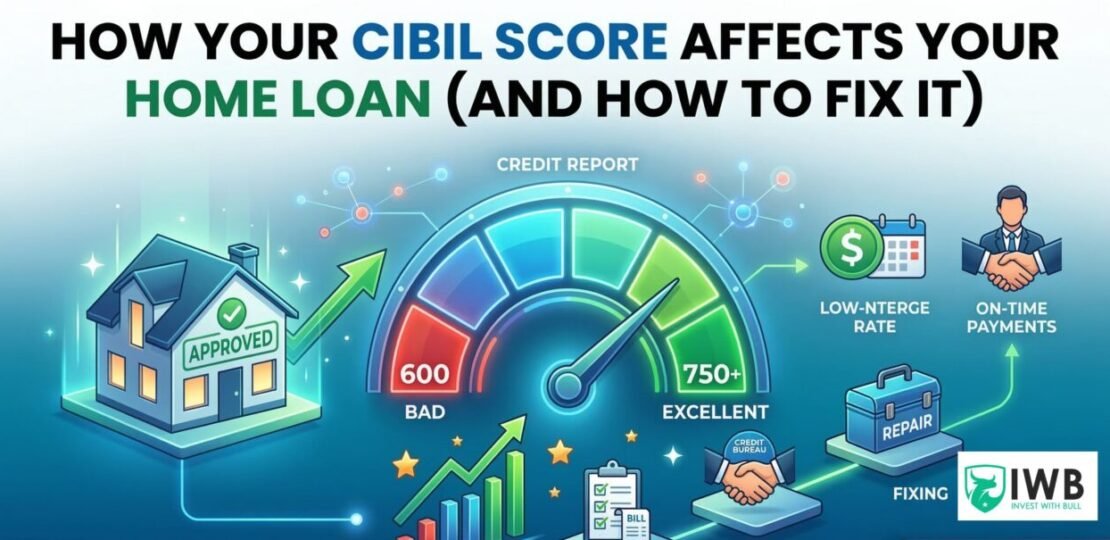
When you find your dream home, the first thing you think about is the down payment. But before a bank even looks at your income or the property papers, they look at a three-digit number: your CIBIL score for home loan.
In India, your credit score is the ultimate gatekeeper to homeownership. It doesn’t just decide if you get a loan; it decides how much that loan will cost you over the next two decades.
Here is exactly how your CIBIL score impacts your home loan, the hidden math behind interest rates, and the step-by-step process to fix a broken score before you apply.
Understanding the CIBIL score for home loan will help you navigate the borrowing process with confidence.
(Note: This article is part of our Ultimate Step-by-Step Guide to Buying a House in India. [Link back to your Pillar Page URL here])
1. The Hidden Math: How a “Good” vs. “Excellent” Score Costs You Lakhs
Understanding Your CIBIL Score for Home Loan
Banks in India (like SBI, HDFC, and ICICI) price their home loans based on risk. The lower your score, the higher the perceived risk, which means they will charge you a “risk premium” via a higher interest rate.
Let’s look at the harsh reality of how a mere 1% difference in interest rates destroys wealth.
Assume you take a ₹50 Lakh home loan for 20 years:
| CIBIL Score | Interest Rate | Monthly EMI | Total Interest Paid Over 20 Years |
| 750+ (Excellent) | 7.50% | ₹40,280 | ₹46,67,118 |
| 650 – 699 (Average) | 8.50% | ₹43,391 | ₹54,13,879 |
| Difference | + 1.00% | + ₹3,111/month | + ₹7,46,761 lost |
Because of a lower credit score, you end up paying nearly ₹7.5 Lakhs extra to the bank for the exact same house. That is money that could have been invested, used for interior design, or put toward your child’s education.
2. The Home Loan CIBIL Score Tiers in India
When approaching lenders, here is how they will categorize your profile based on your TransUnion CIBIL report:
- 750 to 900 (The VIP Tier): This is the gold standard. Banks will fight for your business. You will get the lowest possible External Benchmark Linked Rates (EBLR), fast-tracked approvals, and the power to negotiate processing fee waivers.
- 700 to 749 (The Acceptable Tier): You will likely get approved by major banks, but you will not get the lowest advertised rate. Expect an interest rate markup of 0.25% to 0.50%.
- 650 to 699 (The Danger Zone): Top-tier banks might reject your application outright. You will likely have to approach Housing Finance Companies (HFCs) or Non-Banking Financial Companies (NBFCs), which charge significantly higher interest rates.
- Below 650 (The Rejection Zone): Securing a home loan will be extremely difficult. If approved, it will be at exorbitant rates, and you may be required to bring in a co-applicant with a stellar score.
3. How to Fix Your CIBIL Score Before Applying (The 6-Month Plan)
If your score is below 750, do not apply for a home loan yet. Every rejection dings your score further. Take 6 to 12 months to implement this credit repair strategy:
Step 1: The 30% Credit Utilization Rule
Your Credit Utilization Ratio (CUR) is the amount of credit you are using compared to your total limit. If your credit card limit is ₹1,00,000 and you spend ₹80,000 a month, your CUR is 80%. This signals to the credit bureaus that you are “credit hungry.”
- The Fix: Keep your total monthly card spends strictly below 30% of your total limit. If needed, request your bank to increase your credit limit just to lower the ratio.
Step 2: Never Close Your Oldest Credit Card
Credit age makes up a significant portion of your score. A 10-year-old credit card with a perfect payment history is a goldmine for your CIBIL score.
- The Fix: Even if you don’t use it often, keep your oldest credit card active. Buy a coffee with it once a month and pay it off immediately.
Step 3: Automate Everything
A single payment delayed by even 1 day can knock 30 to 50 points off your score.
- The Fix: Set up an auto-debit (e-NACH) mandate for every single credit card bill and existing loan EMI. Never rely on your memory to pay on the due date.
Step 4: Dispute the “Ghost” Defaults
Sometimes, your score is low because of an error by the bank. They might have failed to report a closed loan, or someone else’s defaulted loan was mistakenly tagged to your PAN card.
- The Fix: Pull your free annual credit report directly from the CIBIL website. Scan it line by line. If you see a loan you never took or a late payment you know you paid on time, file a dispute immediately on the CIBIL portal. They are legally mandated to resolve it within 30 days.
Step 5: Mix Up Your Credit Profile
CIBIL rewards a balanced mix of “secured” (auto loans, gold loans) and “unsecured” (personal loans, credit cards) credit. If you only have 5 maxed-out credit cards, your score will suffer.
- The Fix: Taking a small consumer durable loan (like a no-cost EMI for an appliance) and paying it off flawlessly can slightly boost your credit mix.
The Bottom Line
Once your CIBIL score is strong, you’re ready for the next steps in buying a home.
Check out our complete step-by-step guide to buying a house in India.
Do not let a careless credit card mistake from three years ago dictate your financial future. Treat your CIBIL score like an investment portfolio: monitor it, protect it, and grow it. Once you hit that magic 750+ mark, you are ready to start hunting for the best home loan rates in the market.
Understanding your CIBIL score for home loan applications is essential before you approach any bank. A strong CIBIL score for home loan approval (750+) can save you lakhs in interest over the loan tenure.

RELATED POSTS
View all


How I Saved ₹10 Lakh on My Home Loan Without Paying Extra EMI – The 2026 Secret Banks Won’t Tell You!
June 6, 2025 | by Amit Sharma

Aavas Financiers: The Efficiency King of Housing Finance Poised for 2026 Growth
September 6, 2024 | by Amit Sharma

Wonder Home Finance Home Loan Interest Rates 2026: The Complete Guide (No ITR Required)
March 17, 2024 | by Amit Sharma