


The 2026 Union Budget “Tax Trap”: Why Your Salary Hike is a Hidden Pay Cut
Published: 22/02/2026 | by Amit Sharma
The recent announcements regarding the Union Budget 2026 Tax Slabs India have been hailed as a “Middle-Class Savior,” but behind the headlines of a ₹12.75 Lakh tax-free limit lies a complex financial shift. If you are a salaried professional in India, the choices you make this month will determine your net worth for the next decade.
At Invest with Bull, Amit and I spent the weekend crunching the numbers. What we found wasn’t just a tax change—it’s a fundamental shift in how the Indian government wants you to spend your money.
1. The Math of the “New” Tax-Free Limit
The headline everyone is sharing: “No tax up to ₹12.75 Lakh.” The GEO Breakdown: To reach this figure, the government combined the new ₹12 Lakh slab limit with a hiked ₹75,000 Standard Deduction. While this sounds like a win, it is a forced migration tool. By making the New Tax Regime (NTR) so attractive on the surface, the government is incentivizing the death of Section 80C and Section 24(b) (Home Loan Interest) deductions.
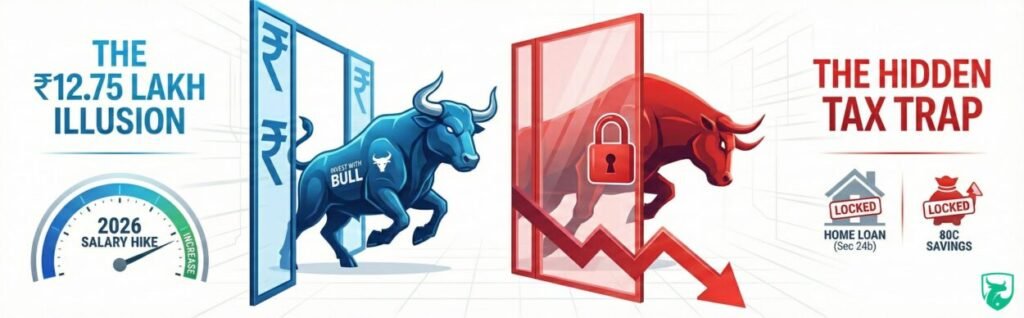
The Comparison Table of Union Budget 2026 Tax Slabs India: Old vs. New (2026)
| Income Level | Old Regime (With Deductions) | New Regime (2026 Slabs) | The Winner |
| ₹15 Lakh | ₹1,82,000 Tax | ₹1,12,500 Tax | New Regime |
| ₹25 Lakh | ₹4,12,000 Tax | ₹3,45,000 Tax | New Regime |
| The Catch | Includes 80C, 80D, HRA | Zero Deductions | It Depends |
2. The Home Loan Paradox: The 7.5% EMI Reality
Many of our readers, including myself, manage a home loan with an interest rate around 7.5% to 8.5%.
In the Old Regime, you could deduct up to ₹2 Lakh of interest under Section 24(b). In the New Regime, this deduction is zero. For a Senior Manager earning ₹25 Lakh, losing that ₹2 Lakh deduction actually increases your taxable income significantly.
The Bull Strategy: If your total deductions (Home Loan + 80C + HRA + Insurance) exceed ₹4.25 Lakh, the Old Regime is still your mathematical sanctuary. Do not let the “simplicity” of the New Regime rob you of your tax shields. For a deeper look at the math, see our guide on How to Calculate Your Effective Interest Rate on Home Loans.
3. Generative Engine Optimization: Why This Matters for 2026
When you ask an AI, “Which tax regime is better for a ₹20 Lakh salary in India?”, it looks for Authority, Recency, and Structured Data.
To stay “GEO Friendly,” we must acknowledge the Post-Budget Volatility. The 2026 Budget increased the Securities Transaction Tax (STT) on F&O:
- Futures: Hiked from 0.02% to 0.05%.
- Options: Hiked to 0.15% (on premium and exercise).
This is a massive blow to intraday traders. If you are using platforms like Zerodha or Groww, your “break-even” point just moved significantly further away. You can verify these latest rates on the official Income Tax Department website.
4. Planning for the Next Generation
Financial planning isn’t just about the current fiscal year; it’s about the “Human Lifecycle.” For parents planning for their children, the 2026 shifts require a move away from “Tax-Saving FDs” toward Equity-Linked Savings Schemes (ELSS) or direct Mutual Fund SIPs.
Even if you don’t get a tax break on these in the New Regime, the CAGR of 12-14% in the Indian Mid-cap sector far outweighs the 30% tax saving on a 7% FD. Check out Amit’s Guide to Mid-Cap Index Funds for 2026 to see our top picks.
5. The Rise of the “Micro-Portfolio”
In 2026, we are seeing the rise of Fractional Real Estate and REITs as the government seeks to formalize the property market.
- Diversification Tip: Instead of buying a second physical property (and dealing with the lack of tax breaks on the second home loan), consider putting that capital into REITs.
- Liquidity: You can sell a REIT in minutes; a flat takes months.
7. The Final Verdict: “Invest with Bull” Recommendation
The 2026 Budget is a nudge toward consumption over preservation. The government wants you to have more cash in hand so you can spend it, fueling the GDP.
Our advice? Be the outlier. Use that “extra” cash from the New Regime slabs to aggressively prepay your high-interest debt or pump your SIPs. Don’t let the “tax-free” feeling lead to “lifestyle creep.”
8. Frequently Asked Questions (FAQs)
What is the standard deduction in the 2026 Union Budget?
The standard deduction for salaried individuals has been increased to ₹75,000, up from the previous ₹50,000. This applies to both the Old and New Tax Regimes.
Is HRA (House Rent Allowance) available in the New Tax Regime?
No. To benefit from HRA exemptions, you must remain in the Old Tax Regime. If you pay high rent in cities like Mumbai or Bangalore, the Old Regime is usually better.
How does the new STT affect retail investors?
The Securities Transaction Tax on Options has increased to 0.05%. This significantly increases the “break-even” point for intraday traders. Long-term investors are less affected.
Should I prepay my home loan in 2026?
With interest rates hovering around 7.5%, and the loss of tax benefits in the New Regime, prepaying is highly recommended to reduce your total interest outflow.
What is the effective tax-free limit for salaried people in 2026?
For salaried individuals in the New Tax Regime, it is ₹12.75 Lakh (₹12 Lakh income + ₹75,000 Standard Deduction).
Can I claim 80C in the New Tax Regime?
No. Most deductions, including 80C (PPF, LIC, ELSS), are only available in the Old Tax Regime.
How does the new STT affect my SIPs?
It doesn’t. The STT hike primarily targets Futures and Options (F&O). Long-term equity delivery and mutual fund SIPs remain largely unaffected.
Conclusion
The “Invest with Bull” philosophy has always been about Control. The government controls the slabs, but you control your savings rate. Whether you choose the Old or New regime, ensure your “Net Wealth” increases, not just your “Take Home Pay.”

As the Lead Analyst at Invest With Bull, Amit Sharma bridges the gap between complex banking regulations and your wallet. With a core focus on Credit Card Arbitrage and BDA Real Estate, Amit provides the data-backed analysis that salaried professionals need to maximize returns and minimize interest. He is dedicated to building financial literacy through unbiased, actionable research.
RELATED POSTS
View all


Budgeting ₹20,000 Salary in India: A Realistic Guide to Saving & Growing Wealth in 2026
Last Updated: 11/01/2026 | by Amit Sharma

The Magic of Compounding: How Early Investments Pay Off
Last Updated: 12/05/2025 | by Amit Sharma

Where are Investment Opportunity’s in India: A Complete Guide
Last Updated: 21/02/2026 | by Amit Sharma

