


The Complete Guide to Tax Implications for NRIs Investing in Indian Mutual Funds (2026) | NRI mutual fund taxation rules 2026
May 19, 2026 | by Amit Sharma

India’s robust economic growth continues to attract global capital, making Indian mutual funds a prime vehicle for Non-Resident Indians (NRIs) looking to build long-term wealth. However, while investing is seamless, NRI mutual fund taxation in India has undergone significant overhauls in recent years. From the standardization of capital gains rates in 2024 to the implementation of the new Income Tax Act, 2025 (effective April 2026), navigating the tax landscape requires careful planning.
This comprehensive guide breaks down the tax implications for NRIs investing in Indian mutual funds in 2026, covering capital gains, dividend taxes, Tax Deducted at Source (TDS), and strategic ways to optimize your returns.
1. Classification of Mutual Funds for Taxation
Before calculating your tax liability, it is critical to understand how the Indian Income Tax Department categorizes your mutual fund investments. The tax rate and holding period depend entirely on the fund’s asset allocation:
- Equity-Oriented Funds: Funds investing a minimum of 65% of their total assets in domestic (Indian) company equity shares.
- Debt-Oriented Funds: Funds investing more than 65% of their assets in debt and money market instruments.
- Hybrid & Other Funds (Gold, International, FoFs): Funds that do not meet the 65% domestic equity criteria. Their taxation depends on their specific equity exposure and whether the units are listed or unlisted.
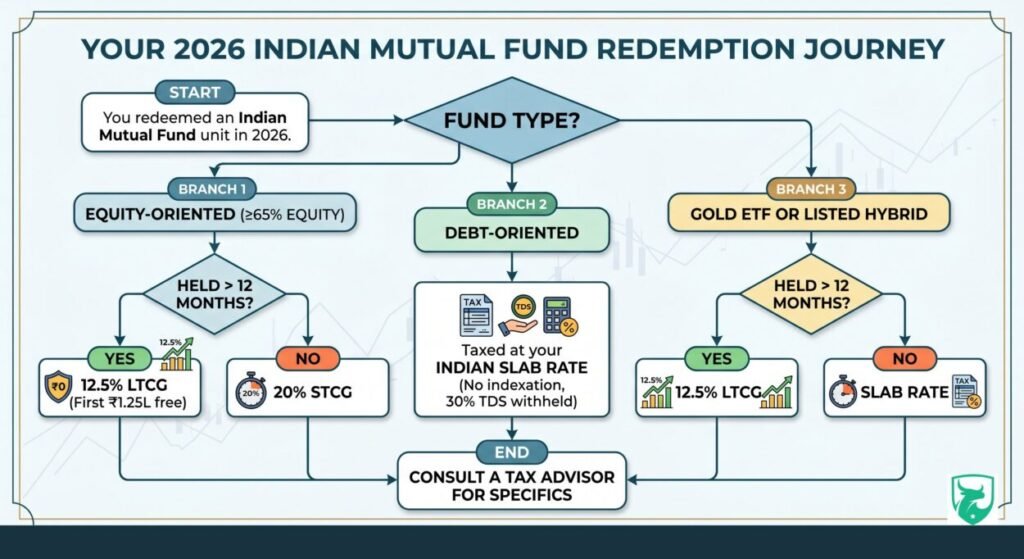
2. Capital Gains Tax Rules for NRI Mutual Fund Taxation (2026)
When you redeem or sell your mutual fund units at a profit, you trigger a “Capital Gain.” For NRIs, the tax structure is closely aligned with resident Indians, but the mechanism of collection (TDS) differs.
A. Equity-Oriented Mutual Funds
The July 2024 Union Budget permanently reshaped equity taxation, and these rules form the bedrock of equity taxation in 2026.
- Short-Term Capital Gains (STCG): If you hold the units for 12 months or less, the gains are taxed at a flat rate of 20% (plus applicable surcharge and 4% Health & Education Cess).
- Long-Term Capital Gains (LTCG): If you hold the units for more than 12 months, the gains are taxed at 12.5%.
- The Exemption Limit: The first ₹1.25 Lakh of LTCG realized across all equity shares and equity mutual funds in a single financial year is completely tax-free.
Example: Rahul, an NRI based in Dubai, invested ₹10 Lakh in an Indian active equity fund in January 2025. He redeems his entire investment in May 2026 for ₹13 Lakh.
- Holding Period: 16 months (Qualifies as LTCG).
- Total Gain: ₹3,00,000.
- Taxable Gain: ₹3,00,000 – ₹1,25,000 (Exemption) = ₹1,75,000.
- Tax Liability: 12.5% of ₹1,75,000 = ₹21,875 (plus cess/surcharge).
B. Debt-Oriented Mutual Funds
Debt fund taxation has lost its historical “indexation” edge. The rules for 2026 are straightforward but stringent.
- For investments made on or after April 1, 2023: All capital gains, regardless of how long you hold the fund, are treated as Short-Term Capital Gains. They are added to your total Indian income and taxed according to your applicable income tax slab rate. There is absolutely no indexation benefit.
Example: Priya, an NRI in the USA, invested ₹5 Lakh in a debt mutual fund in June 2024. She redeems it in August 2026 for ₹6 Lakh.
- Total Gain: ₹1,00,000.
- Tax Liability: The entire ₹1 Lakh is added to her Indian income and taxed at her respective slab rate. (Note: The AMC will deduct TDS at 30%, and she must claim a refund by filing an ITR if her actual tax slab is lower).
C. Hybrid, Gold, and International Funds
For funds that do not fit the pure equity or pure debt definitions (like Gold ETFs, International Fund of Funds, or conservative hybrids), the rules depend on listing status:
- Listed Units (e.g., Gold ETFs): Qualify for LTCG after 12 months and are taxed at 12.5% (without indexation).
- Unlisted Units (e.g., many FoFs): Qualify for LTCG after 24 months and are taxed at 12.5% (without indexation).
- STCG: Taxed at your applicable income tax slab rate.
3. Taxation on Dividends (IDCW) & The 2026 Budget Update
Many NRIs opt for the Income Distribution cum Capital Withdrawal (IDCW) plan to generate passive income.
- Taxability: Dividend income is fully taxable in the hands of the NRI investor. It is classified under “Income from Other Sources” and taxed at the investor’s applicable slab rate.
- The 2026 Rule Change: Under the new Income Tax Act, 2025 (effective April 1, 2026), the government has closed a previous loophole. You can no longer claim any deduction for interest expenditure incurred to earn dividend income. Previously, investors could deduct interest expenses up to 20% of their dividend income. From FY 2026-27 onward, the gross dividend received is fully taxable.
4. Tax Deducted at Source (TDS) Rules for NRIs
The most critical difference between resident and NRI mutual fund taxation is TDS. Because the Income Tax Department cannot easily track non-residents, Asset Management Companies (AMCs) are mandated to deduct tax before crediting the redemption or dividend amount to your NRE/NRO account.
Summary of NRI TDS Rates (2026)
| Mutual Fund Category | Type of Gain / Income | Holding Period | Applicable TDS Rate (Excluding Surcharge/Cess) |
| Equity-Oriented Funds | Short-Term (STCG) | Up to 12 Months | 20% |
| Equity-Oriented Funds | Long-Term (LTCG) | Over 12 Months | 12.5% |
| Debt-Oriented Funds | Any Gain | Any Period | 30% (Since the AMC does not know your slab rate) |
| All Mutual Funds | Dividend (IDCW) | N/A | 20% |
Note: The actual TDS deducted will include the applicable surcharge and a 4% Health & Education Cess.
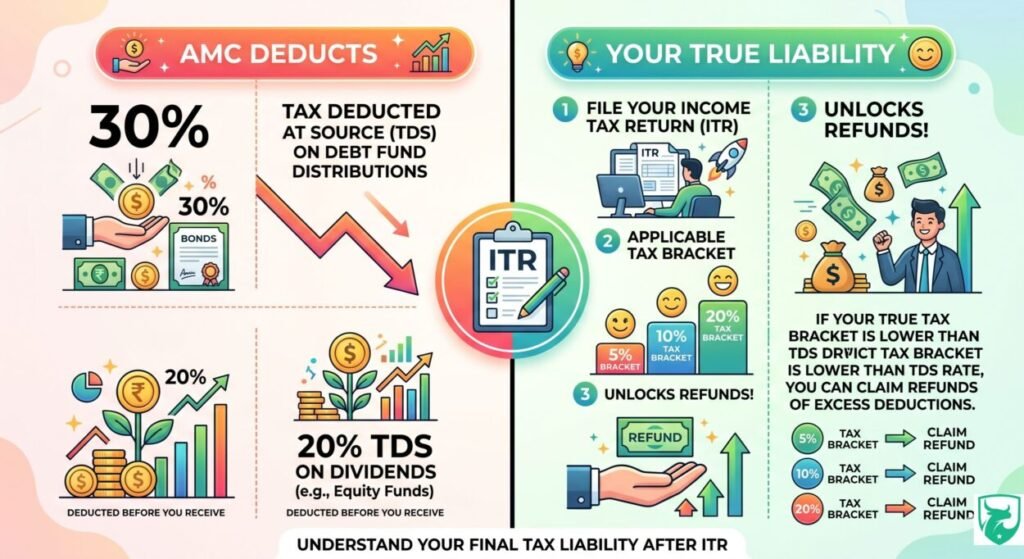
Important Tip for NRIs: Because AMCs deduct TDS at the maximum possible rate for debt funds (30%), NRIs whose actual total income in India falls into a lower tax bracket (e.g., 5% or 20%) must file an Income Tax Return (ITR) in India to claim a tax refund.
5. Relief from Double Taxation (DTAA)
A common worry for NRIs is paying tax twice: once in India (via TDS) and again in their country of residence (like the USA, UK, or Canada).
India has signed the Double Taxation Avoidance Agreement (DTAA) with over 90 countries. By invoking the DTAA, NRIs can:
- Pay taxes only in one country, or
- Claim a foreign tax credit in their home country for the TDS already paid in India.
To benefit from DTAA or to ensure the AMC applies a lower, treaty-agreed TDS rate (if applicable), you must proactively submit your Tax Residency Certificate (TRC) and Form 10F to the mutual fund house.
6. Key Takeaways for the 2026 NRI Investor
- Equity Remains King for Tax Efficiency: With a 12.5% LTCG rate and a ₹1.25 Lakh annual exemption, equity mutual funds remain the most tax-efficient wealth creation tool for NRIs.
- Rethink Debt Funds: Without indexation benefits, debt mutual funds act strictly as portfolio stabilizers rather than tax-efficient growth assets.
- File Your ITR: Even if TDS has been deducted, filing an Income Tax Return in India is highly recommended. It is the only way to claim refunds on excess TDS deducted (especially on debt funds and dividends) and to carry forward capital losses to offset future gains.
- Embrace the New Rules: Be aware that from April 2026, offsetting interest against your mutual fund dividends is no longer permitted. Plan your cash flows accordingly.

How to Start a SIP in Mutual Funds for Lazy People (2026)
FAQs
Q1: Is the ₹1.25 Lakh LTCG tax exemption available to NRIs, or is it only for residents?
Yes, the ₹1.25 Lakh exemption on Long-Term Capital Gains (LTCG) from equity-oriented funds applies to NRIs as well. It is an aggregate limit for the financial year across all your equity mutual funds and listed stocks. However, note that while you enjoy this exemption on your final tax liability, the fund house (AMC) might still deduct TDS on the total gains during redemption. You will need to file an Indian Income Tax Return (ITR) to claim a refund for any excess tax withheld.
Q2: Why do AMCs deduct 30% TDS on debt funds if my actual tax slab is lower?
Mutual fund houses do not have visibility into your total global or Indian income, meaning they cannot determine your specific income tax slab. By default, the law mandates them to deduct TDS at the highest tax bracket (30% plus applicable surcharge and cess) on capital gains from debt funds. To recover the excess tax deducted, you must file an ITR in India to report your actual slab and claim a refund.
Q3: Can US and Canada-based NRIs freely invest in all Indian mutual funds?
No, there are compliance restrictions. Due to strict reporting requirements under FATCA (Foreign Account Tax Compliance Act) and CRS, many Indian Asset Management Companies (AMCs) do not accept investments from NRIs residing in the USA or Canada. However, several major fund houses (like ICICI Prudential, HDFC, SBI, and UTI) do allow them, though often with specific conditions (such as investing only via offline mode or through specific banking channels). Always check the AMC’s compliance policy before investing.
Q4: What happens to my mutual fund investments if my status changes from NRI to Resident?
If you move back to India permanently, your tax status changes to a Resident Indian under FEMA and the Income Tax Act. You must proactively notify your bank and the mutual fund houses (via your KYC registration agency) to update your status from NRI to Resident. Your future redemptions will no longer be subject to automatic TDS, and your investments will follow resident taxation rules moving forward.
Q5: Can I repatriate the money I make from selling Indian mutual funds?
Repatriation depends on the account type used to invest:
NRE (Non-Resident External) Account: If you invested using clean foreign currency through an NRE account, the principal and all capital gains are fully and freely repatriable back to your country of residence.
NRO (Non-Resident Ordinary) Account: If you invested using Indian income (like rental income or dividends) via an NRO account, repatriation is subject to a limit of $1 million USD per financial year, and you will require a chartered accountant’s certificate (Form 15CA/15CB) to move the funds abroad.

RELATED POSTS
View all


JioBlackRock Mutual Fund Complete Guide for Indian Investors
September 29, 2025 | by Amit Sharma

How to Start a SIP in Mutual Funds for Lazy People (2026): 7 Easy Ways to Grow Money
January 22, 2026 | by Amit Sharma