


Airport Lounge Access is No Longer Free: The 2026 List of Cards That Actually Work
Published: 15/02/2026 | by Amit Sharma

Why your “Lifetime Free” card might get rejected at the airport counter this summer (and which cards are safe).
Imagine this: You reach the airport 3 hours early, excited for a free meal and a comfortable sofa before your flight. You hand over your credit card, and the receptionist hands it back with a polite smile: “Sorry sir, you are not eligible.”
In 2026, this is becoming the new normal for Indian travelers.
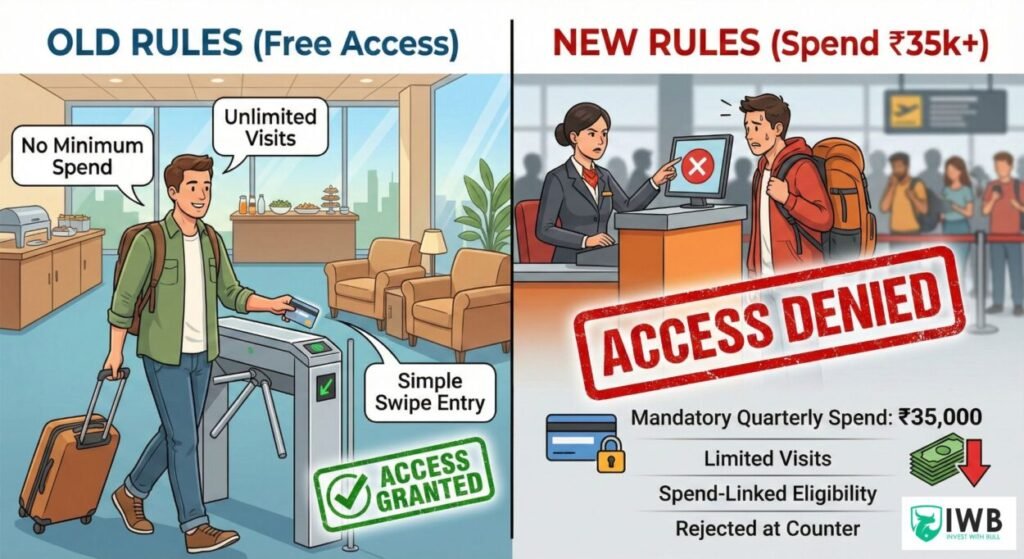
Gone are the days when any entry-level credit card got you into the lounge. Following the aggressive devaluations by HDFC, ICICI, and Axis Bank in late 2025, the rules of the game have changed. Most banks have shifted from “Unconditional Access” to “Spend-Based Access.”
If you are a salaried professional planning your summer holidays, here is the reality check you need—and the 5 cards that still keep the lounge doors open.
The New Rule: “Spend to Enter”
Banks realized they were losing money on free sandwiches. To fix this, they introduced a hurdle: Quarterly Spend Milestones.
- The Old Way: Show your card, swipe ₹2, enter.
- The 2026 Way: You must have spent ₹35,000 to ₹50,000 on your card in the previous calendar quarter to unlock access for the current quarter.
If you have a card lying in your drawer that you only use for lounges, it is now officially a piece of plastic junk.
The “Safe List”: 5 Cards That Still Work (2026 Edition)
If you don’t want to track your spending every month just to get a cup of coffee, you need cards that still offer unconditional or easy-access privileges.
1. The Heavyweights: HDFC Infinia & Diners Black
- Status: Unconditional.
- Why: These super-premium cards remain the gold standard. No spend criteria, no questions asked. You get unlimited access for yourself and unlimited add-on cards for your family.
- Verdict: If you earn >₹3L/month, this is the only card you need.
Internal Link:Read our full review of the HDFC Infinia Metal 2026 here
2. The Mid-Range Hero: Axis Bank Horizon
- Status: Unconditional (For now).
- Why: While the Axis Magnus fell from grace, the Horizon card quietly became a favorite. It offers decent lounge access limits without the insane spend requirements of its bigger brothers.
- Best For: Frequent flyers who want miles + access.
3. The Budget King: Federal Scapia
- Status: Low Spend Criteria.
- Why: Scapia disrupted the market by offering a “Zero Forex” card that is Lifetime Free. While they have introduced a spend requirement (₹5,000/month in some cases), it is much lower than the ₹35,000 asked by big banks.
- Verdict: The best secondary card for your wallet.
4. The Specific Traveler: IDFC First Wealth
- Status: Easy Access.
- Why: IDFC First continues to be generous. Their Wealth card offers domestic and international lounge access with very reasonable terms compared to ICICI or SBI.
- Bonus: It also has one of the lowest forex markups in the market.
Cards to Avoid (For Lounges)
Be careful with these popular cards. They are great for rewards, but bad for instant lounge access unless you are a heavy spender:
- ICICI Coral/Rubyx: High quarterly spend requirement.
- HDFC Millennia: Access is now strictly linked to spending ₹1 Lakh in a quarter.
- Flipkart Axis: No longer reliable for lounge access.
3 Steps to Avoid Rejection
- Check the App: Open your bank’s mobile app 48 hours before flying. Most (like DreamFolks or Priority Pass) will show your “Available Visits” in real-time.
- Use Your Primary Card: Don’t rely on Add-on cards unless they are explicitly premium (like Infinia).
- Switch to RuPay: If your Visa/Mastercard limit is exhausted, check if you have a RuPay Platinum Debit card. Surprisingly, many government-backed debit cards still have unconditional access!
External Link: Check the officialDreamFolks Websiteto see the list of lounges accepting your card network.
FAQs
When do the new RBI credit card rules for 2026 come into effect?
Most of the new provisions, including the mandate for Weekly CIBIL Reporting, are scheduled to be fully operational by April 1, 2026. However, banks have already started implementing the “Explicit Consent” rules for credit limit increases and card upgrades as of early 2026.
How does the new “Weekly Credit Reporting” affect my CIBIL score?
Under the new regime, banks report your payment behavior to credit bureaus (like CIBIL and Experian) every 7 days (specifically on the 7th, 14th, 21st, and 28th of the month).
The Good: If you pay off a high balance, your score improves almost immediately.
The Bad: If you miss a due date, the negative impact reflects on your report within a week, rather than the old 30-45 day lag.
Can banks charge interest on GST and late fees?
No. The RBI has strictly prohibited the “compounding” of taxes. Banks can now only charge interest on the actual principal amount (the money you spent). They cannot levy interest on unpaid Goods and Services Tax (GST) or previously charged late payment fees.
What happens if I don’t activate a new credit card?
If a new credit card is not activated via OTP within 30 days of issuance, the bank must seek your consent to keep it open. If you decline or don’t respond, the bank is legally required to close the credit card account within 7 days at zero cost to you. They cannot charge a joining fee for an inactive card.
Can I change my credit card billing date to match my salary?
The RBI Master Direction gives every cardholder a one-time right to modify their billing cycle. You can contact your bank (via app or customer care) and request a statement date that aligns with your salary credit (e.g., changing it from the 15th to the 5th).
Is it mandatory to enable tokenization for online payments?
For security purposes, RBI mandates Card-on-File (CoF) Tokenization. Merchants (like Amazon, Flipkart, Zomato) can no longer store your actual 16-digit card number. You must create a unique “Token” for each merchant, which makes your transactions significantly safer against data breaches.
Can a bank increase my credit limit without asking?
No. Banks are prohibited from increasing credit limits or upgrading card variants (e.g., from Millennia to Regalia) without explicit digital consent from the customer. If a bank increases your limit without your OTP approval, you can file a complaint with the RBI Ombudsman.
Do these rules apply to “Buy Now Pay Later” (BNPL) cards?
Yes. The RBI’s directions on credit reporting and fair practices apply to all authorized prepaid payment instruments and BNPL services that report to credit bureaus.
Final Verdict
The era of “free” luxury is over. In 2026, lounge access is a reward for active spenders, not just cardholders.
If you are a salaried employee, stop chasing “Lifetime Free” cards that offer nothing. Instead, pay a small annual fee for a card like the SBI Prime or Amex Platinum Travel that guarantees you peace of mind—and a quiet place to sit.
Which card are you carrying for your next flight? Let me know in the comments!

Amit Sharma is the Lead Analyst at Invest With Bull, leveraging 11 years of market experience to simplify personal finance for salaried professionals. From mastering credit card arbitrage and navigating personal loans to structuring robust retirement and FIRE (Financial Independence, Retire Early) strategies, Amit provides data-backed, actionable analysis. His mission is to cut through complex banking jargon and deliver the unbiased research you need to achieve absolute financial freedom.
RELATED POSTS
View all


How to Budget ₹25,000 Salary in India Without Feeling Broke (2026 Guide)
Last Updated: 11/01/2026 | by Amit Sharma
HDFC Millennia Credit Card Eligibility 20000 Salary: 4 Secret Hacks!
Last Updated: 30/01/2026 | by Amit Sharma
