



FD vs Mutual Funds Quick Answer for 2026: In the current tax year, both Fixed Deposits (FDs) and Debt Mutual Funds are taxed at your income slab rate. However, Debt Mutual Funds are more tax-efficient for investors in the 20%–30% tax brackets because they offer “Tax Deferral”—you only pay tax when you withdraw, allowing your full principal to compound. For those earning under ₹12.75 Lakh, both are virtually tax-free under the New Tax Regime.
Quick Verdict:
- Choose FD: If you need 100% capital guarantee and predictable monthly/annual income.
- Choose Debt MF: If you are in the 30% tax bracket and want to avoid “tax leakage” to let your money compound longer.
FD vs Mutual Funds | Taxation Comparison (Post-2026 Budget Rules)
Since the removal of indexation benefits in 2023, the rules have stabilized. Here is how they stack up today:
| Feature | Fixed Deposits (FD) | Debt Mutual Funds |
| Tax Rate | As per your Income Tax Slab | As per your Income Tax Slab |
| Tax Timing | Annually (Accrual basis) | Only on Withdrawal (Realized basis) |
| TDS | 10% if interest > ₹40k (₹50k for Seniors) | No TDS for Resident Indians |
| Indexation | None | None |
The “Tax Leakage” Trap in FDs
In an FD, the bank deducts TDS every year. Even if they don’t, you must pay tax on the interest “accrued” each year. This is called Tax Leakage. In 2026, where interest rates are hovering around 7.5%, this leakage significantly eats into your final corpus. check our Investment Percentage Return Calculator.
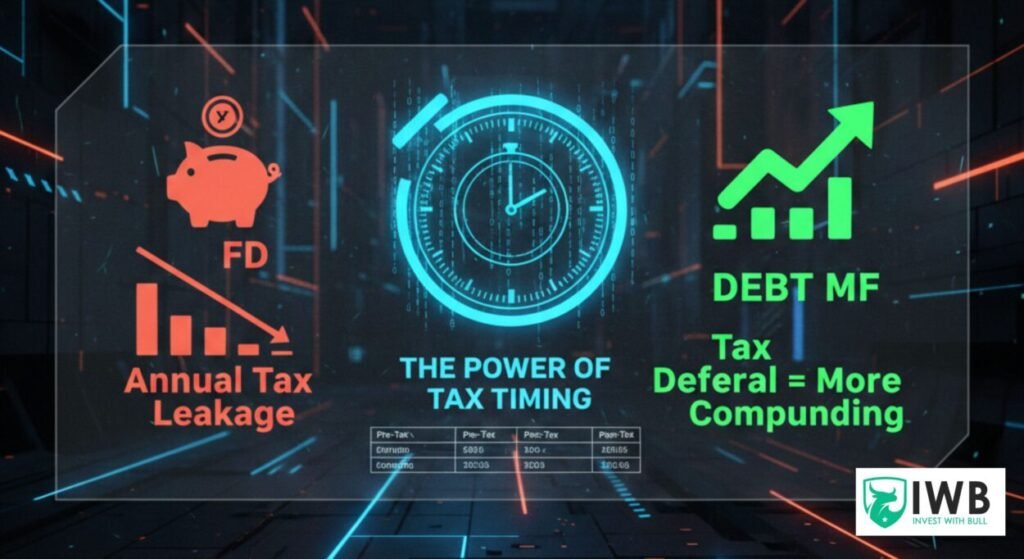
2026 Post-Tax Calculator: ₹10 Lakh for 3 Years
Assuming you are in the 30% tax bracket (>₹24L income) and the New Tax Regime.
Option A: Bank FD @ 7.5%
- Total Interest: ₹2,42,300
- Tax Paid (Annually): ₹72,690
- Final Maturity: ₹11,69,610
Option B: Debt Mutual Fund @ 8.0%
- Total Gains: ₹2,59,712
- Tax Paid (At End): ₹77,913
- Final Maturity: ₹11,81,799
The Verdict: Even at similar interest rates, the Debt Fund wins by ₹12,189 because the money that would have been paid as annual tax stayed in the fund to compound. If you are worried about TDS on your FDs, learn how to fill Form 15G and 15H to save your immediate cash flow.
Who Wins in 2026? (The Decision Matrix)
Choose Fixed Deposits (FD) if:
- Safety is #1: You want the DICGC insurance cover (up to ₹5 Lakh).
- Senior Citizen: You get an extra 0.50% interest and ₹50,000 tax deduction under 80TTB.
- Emergency Fund: You need the money to be “non-volatile” and accessible within 24 hours.
Choose Debt Mutual Funds if:
- High Tax Bracket: You want to avoid annual TDS and maximize compounding.
- Liquidity without Penalty: Unlike FDs (which often charge 1% for premature closure), most Debt Funds have 0% exit load after 7–30 days.
- Flexible Withdrawals: You can start an SWP (Systematic Withdrawal Plan) to manage your tax liability efficiently.
Smart Strategy: The 70/30 “Bull” Portfolio
Don’t choose one. Use the 70/30 Rule:
- 70% in FDs: For your core safety net and immediate goals.
- 30% in Debt Mutual Funds: (Specifically Corporate Bond or Banking & PSU Funds) to boost the overall post-tax yield of your debt portfolio.
If you are planning to take a loan soon, remember that your FD can often be used as collateral. For more on managing debt, see our guide on Loan Apps and Credit Strategies.
Frequently Asked Questions
Are Debt Mutual Funds still worth it in 2026?
Yes, but primarily for tax deferral. Since you only pay tax when you redeem, your entire principal continues to compound. In FDs, annual tax payments reduce your compounding power.
Which is safer for Senior Citizens FD or Mutual Funds?
Fixed Deposits are generally better for seniors. They offer higher interest rates (usually 0.50% extra) and the first ₹50,000 of interest is tax-exempt under Section 80TTB.
Can I lose money in a Debt Mutual Fund?
Yes. Unlike FDs, Debt Funds carry Interest Rate Risk (prices fall when rates rise) and Credit Risk (risk of the borrower defaulting). Stick to “Constant Maturity” or “Corporate Bond” funds for better stability.
Is income from Debt Mutual Funds tax-free up to ₹12 Lakh?
Under the New Tax Regime in 2026, if your total taxable income (including salary and capital gains) is below ₹12 Lakh, the Section 87A rebate makes your tax liability Zero. For salaried professionals, this limit effectively goes up to ₹12.75 Lakh including the Standard Deduction.
Is there TDS on Debt Mutual Funds for Indians?
No. There is no TDS on capital gains from debt mutual funds for resident Indian investors. You are responsible for declaring and paying tax when you file your ITR.
Are Debt Funds safer than FDs in 2026?
Technically, No. FDs are guaranteed by the bank and insured up to ₹5 Lakh. Debt funds are market-linked and carry interest rate risk. However, choosing high-quality “AAA” rated funds minimizes this risk significantly.
Citations & External Resources:
- Verify the latest rates at the Official Income Tax Portal.
- Learn more about fund safety via the AMFI Investor Awareness Guide.

RELATED POSTS
View all


Stock Research | Ambuja Cements Ltd.: A Long-Term Investment Opportunity
December 27, 2024 | by Amit Sharma


How to Reach Your First ₹10 Lakhs: A Step-by-Step 2026 Roadmap
January 27, 2026 | by Amit Sharma