



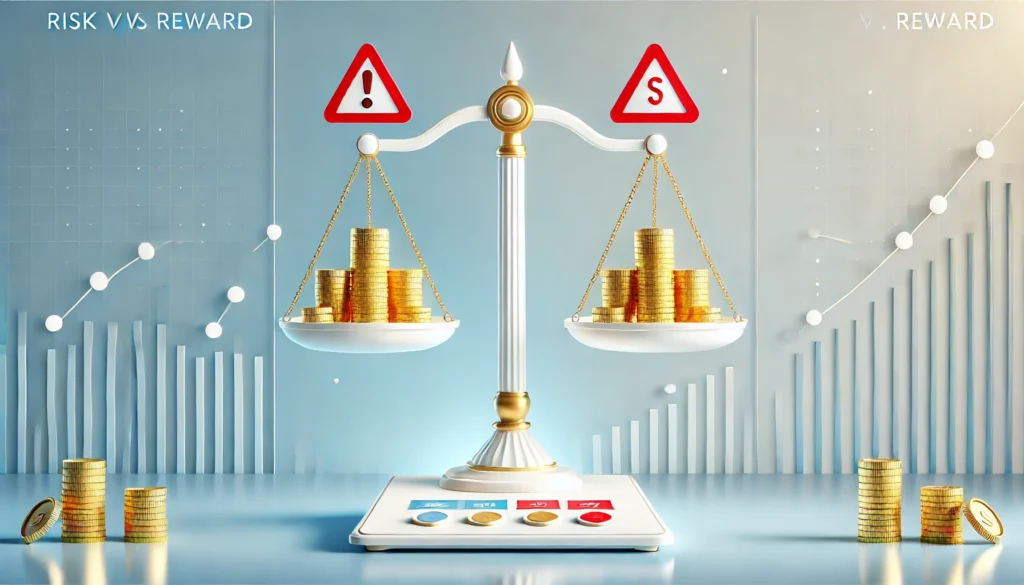
Investing is a constant balancing act between risk vs reward. Every financial decision you make involves a trade-off: the potential for higher returns usually comes with higher risks, while safer investments often yield lower returns. Understanding this dynamic is crucial for creating an investment strategy that suits your financial goals and personal comfort level.
Your risk appetite—or your willingness and ability to take risks—plays a critical role in deciding how much risk you can afford to take for the returns you expect. Whether you’re a conservative investor seeking stability, a moderate investor aiming for balance, or an aggressive investor chasing high returns, knowing where you stand on the risk spectrum can help you achieve your goals without unnecessary stress.
This guide will walk you through the concept of risk vs. return, explain how to determine your risk appetite, and provide actionable tips to align your investments with your financial aspirations.
What Is Risk Appetite?
Risk appetite refers to the amount of financial risk you’re willing and able to take to achieve your investment goals. It’s a personal measure that depends on a variety of factors, such as:
- Age: Younger individuals with longer time horizons can afford higher risks.
- Financial Goals: Goals like retirement planning or buying a home influence your risk-taking capacity.
- Income Stability: Consistent income allows for higher-risk investments.
- Personality and Psychology: Are you comfortable seeing market fluctuations, or do you lose sleep over it?
Risk vs Reward in Investing
The concept of risk vs. reward lies at the heart of every investment decision. It represents the trade-off between the potential gains an investor can achieve and the level of uncertainty they must accept to pursue those gains. Higher-risk investments, such as small-cap stocks, sectoral funds, or cryptocurrencies, often come with the promise of greater returns, but they also carry a higher probability of losses.
Conversely, lower-risk options like government bonds, fixed deposits, or savings accounts provide stability and predictability but typically yield modest returns. Striking the right balance between risk and reward is essential to achieving financial goals while managing emotional and financial comfort. This balance depends on factors like an investor’s financial situation, investment horizon, and personal risk tolerance, making it vital to assess these elements before committing to any investment strategy.
What Is the Risk vs Reward Calculation?
The Risk-Return Relationship
The risk vs return trade-off is a cornerstone of investing. Here’s how it works:
- Low Risk, Low Return: Investments such as government bonds, fixed deposits, and savings accounts.
- Moderate Risk, Moderate Return: Balanced mutual funds, index funds, and blue-chip stocks.
- High Risk, High Return: Small-cap stocks, cryptocurrencies, and derivatives.
The idea is to select investments that align with your comfort level and long-term objectives.
Types of Investors
1. Conservative Investors
- Focus: Capital preservation
- Investment Preference: Fixed deposits, PPF, bonds, and debt funds
- Example: A retiree or someone approaching retirement who prioritizes safety over growth.
2. Moderate Investors
- Focus: Balanced growth and safety
- Investment Preference: A mix of equity and debt investments, such as hybrid mutual funds
- Example: A middle-aged individual saving for children’s education and retirement.
3. Aggressive Investors
- Focus: Maximizing returns
- Investment Preference: High-risk options like equity mutual funds, small-cap stocks, and cryptocurrencies
- Example: A young professional with a steady income and long-term goals.
How to Determine Your Risk Appetite
Understanding your risk appetite is a critical step in financial planning. Here’s how you can determine it:
- Define Your Financial Goals
Identify your short-term and long-term goals. Long-term goals (retirement or wealth creation) may allow higher risks, while short-term ones (buying a car) require safer investments. - Evaluate Your Financial Health
Look at your monthly income, savings, liabilities, and emergency fund to understand how much risk you can afford. - Use Risk Profiling Tools
Many online tools and investment platforms provide questionnaires to assess your risk tolerance. - Consider Emotional Comfort
Think about how you’d react to market volatility. If fluctuations cause anxiety, you might lean toward lower-risk options. - Revisit Your Risk Appetite Regularly
Life events like marriage, parenthood, or career changes can alter your financial outlook and risk tolerance.
Tips for Balancing Risk and Return
Achieving a balance between risk and return is key to successful investing. Here are some tips:
- Diversify Your Portfolio: Spread investments across asset classes like stocks, bonds, mutual funds, and real estate to reduce overall risk.
- Start Small: If you’re new to investing, begin with low-risk options and gradually explore higher-risk assets.
- Invest Regularly: Use SIPs (Systematic Investment Plans) to reduce the impact of market volatility.
- Stay Educated: Understand the risks associated with each investment type before committing your funds.
- Seek Professional Guidance: Consult a financial advisor if you’re unsure how to balance your risk and return.
FAQs
1. What is the risk vs return trade-off in investing?
The risk-return trade-off means that higher risks usually offer the potential for higher returns, while lower risks come with lower returns.
2. How does age affect my risk appetite?
Younger investors typically have a higher risk appetite because they have more time to recover from potential losses.
3. What is a conservative investment strategy?
A conservative investment strategy focuses on capital preservation and includes low-risk options like fixed deposits, bonds, and PPF.
4. How can I measure my risk appetite?
You can measure your risk appetite by assessing your financial goals, income stability, emotional tolerance for market fluctuations, and using online risk profiling tools.
5. What are the best investments for high-risk investors?
High-risk investors often prefer small-cap stocks, sectoral funds, equity mutual funds, and cryptocurrencies.
6. Should I adjust my risk appetite as I age?
Yes, your risk appetite typically decreases with age. As retirement approaches, it’s advisable to shift toward safer investments.
7. Can diversification reduce risk in my portfolio?
Absolutely! Diversification spreads your investments across various asset classes, reducing the impact of losses in any single asset.
8. How does inflation impact my risk-return balance?
Inflation erodes the value of returns, making it important to include growth-oriented investments like equities in your portfolio to outpace inflation.
Conclusion
Understanding your risk appetite is the foundation of a successful investment strategy. By evaluating your financial goals, current situation, and comfort level, you can create a balanced portfolio that aligns with your needs. Remember, your risk tolerance isn’t static—it evolves with life events, income changes, and market conditions.
With the right balance of risk and return, you can work toward achieving your financial dreams while staying within your comfort zone.

RELATED POSTS
View all


Airport Lounge Access is No Longer Free: The 2026 List of Cards That Actually Work
February 15, 2026 | by Amit Sharma


750 Is the New 650: Why Your Credit Score Rules Changed in 2026 (And How to Hack It)
January 19, 2026 | by Amit Sharma